Digital Thermostats
On/Off vs 0-10V Valve Control: How to Choose the Right FCU Thermostat?
When selecting a thermostat for a fan coil unit, people often focus first on whether the system is 2-pipe or 4-pipe, or whether the fan is 3-speed or EC.
Valve control is just as important.
A thermostat designed for an On/Off valve cannot automatically be used for a 0-10V modulating valve. The control signal, wiring and application are different.
So before choosing an FCU thermostat, it is important to confirm exactly how the valve is controlled.
What Does the Valve Do in an FCU System?
In a typical fan coil system, the valve controls the flow of chilled or hot water through the coil.
The thermostat decides when cooling or heating is required and sends a signal to the valve actuator.
The most common valve control types are:
- ● On/Off control
- ● 0-10V modulating control
- ● 3-point floating control
For many commercial FCU projects, On/Off and 0-10V are the two most common options.
The valve requirement also depends on whether the FCU uses a 2-pipe or 4-pipe configuration. If you are not sure about the difference, see our guide on how to select an FCU thermostat for 2-pipe and 4-pipe systems.
How Does an On/Off Valve Work?
An On/Off valve has two basic positions:
Open or closed.
When the room temperature moves away from the setpoint, the thermostat switches the valve output on. When the set temperature is reached, the thermostat switches the valve off.
This type of control is simple and widely used.
Typical applications include:
- ● Hotels
- ● Apartments
- ● Residential buildings
- ● Standard office FCU systems
- ● Retrofit projects
On/Off valve control is often selected because the wiring is simple, commissioning is straightforward, and the overall system cost is relatively low.
For many conventional fan coil applications, it is still a practical solution.
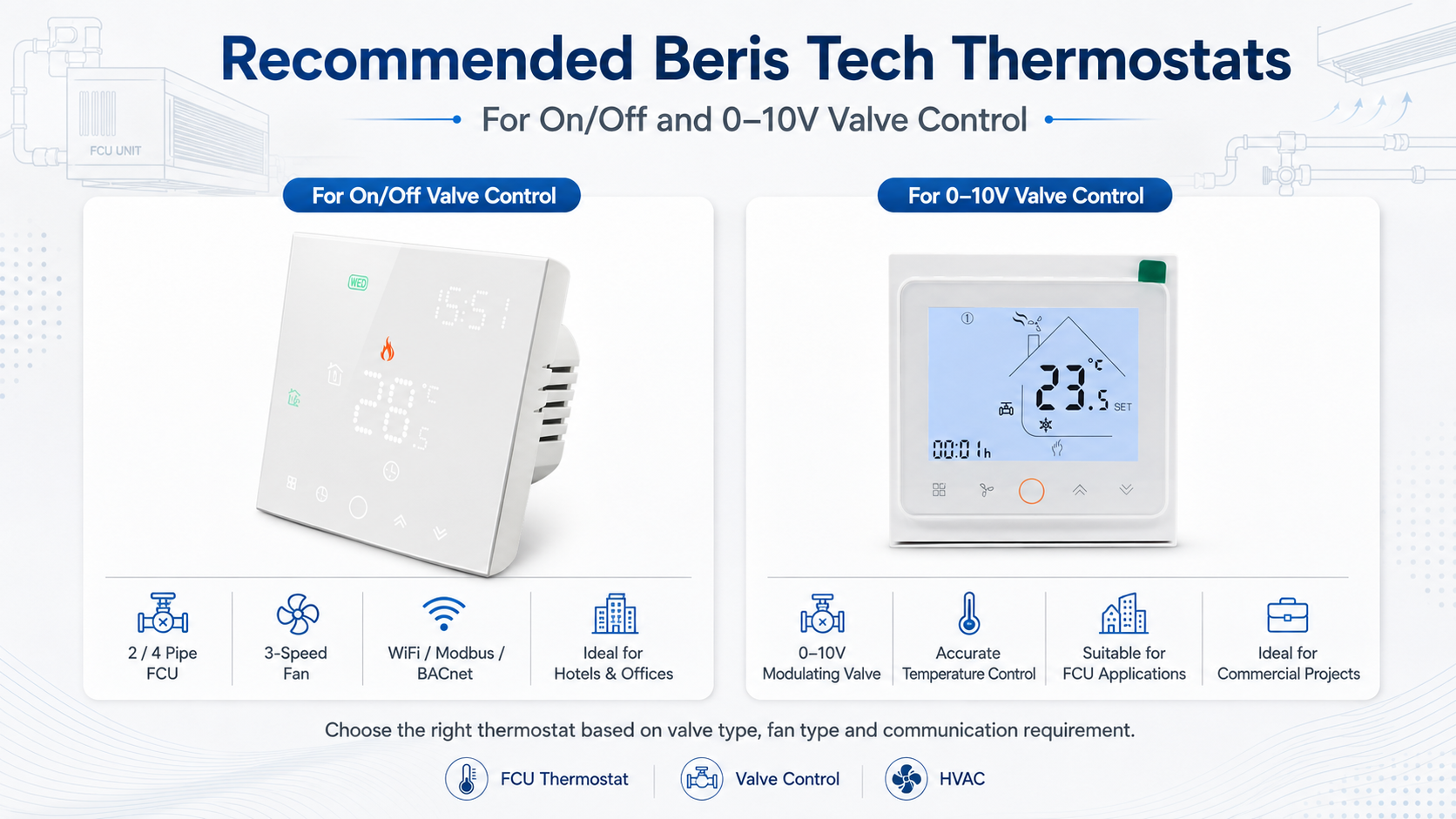
Beris Tech Thermostats for On/Off Valve Control
For standard FCU systems using On/Off motorized valves, Beris Tech BT02-FCU series offers several configurations for 2-pipe and 4-pipe systems.
Depending on the project, the thermostat can support:
- ● 2-pipe or 4-pipe FCU
- ● 3-speed fan control
- ● On/Off valve control
- ● WiFi, Modbus or BACnet communication
- ● 24VAC or 230VAC power supply
This makes it suitable for hotels, offices, apartments and general commercial HVAC projects.
→ View Beris Tech BT02 FCU Thermostat configurations
How Does a 0-10V Modulating Valve Work?
A 0-10V valve works differently.
Instead of simply opening or closing the valve, the thermostat sends an analog signal to control the valve position.
For example, depending on the actuator design:
- ● A low voltage signal may keep the valve near the closed position
- ● A mid-range signal may partially open the valve
- ● A higher signal may open the valve further
This allows the water flow through the coil to change gradually according to the heating or cooling demand.
The result is smoother control compared with a simple On/Off valve.
0-10V valve control is commonly used in projects where more precise room temperature control or better part-load performance is required.
Typical applications include:
- ● Commercial buildings
- ● Office projects
- ● Premium hotels
- ● BMS-controlled HVAC systems
- ● Projects using modulating valve actuators
The exact relationship between the control voltage and valve position depends on the actuator manufacturer and its configuration, so the valve datasheet should always be checked before thermostat selection.
Beris Tech Thermostats for 0-10V Valve Control
For projects using a 0-10V modulating valve, Beris Tech offers several thermostat configurations.
For example, the BT06-FCU-2MNE is designed for 2-pipe FCU systems with:
- ● 0-10V modulating valve output
- ● 3-speed fan control
- ● Modbus RS485
- ● External temperature sensor support
- ● 24VAC / 110VAC / 220VAC power options
It is a practical choice for commercial buildings and BMS projects where modulating valve control and Modbus communication are required.
→ View BT06 0-10V Modulating FCU Thermostat
For projects that require WiFi remote control together with a 0-10V modulating valve, the BT01 WiFi Modulating FCU Thermostat is another option.
On/Off vs 0-10V Valve Control
| Feature | On/Off Valve | 0-10V Modulating Valve |
|---|---|---|
| Control method | Open / Close | Variable position |
| Thermostat output | Relay output | Analog 0-10V output |
| Wiring | Simpler | More complex |
| Temperature control | Standard | More precise |
| System cost | Lower | Higher |
| Commissioning | Easier | Requires signal matching |
| Typical application | Standard FCU projects | Higher-spec commercial projects |
| Part-load control | Limited | Better |
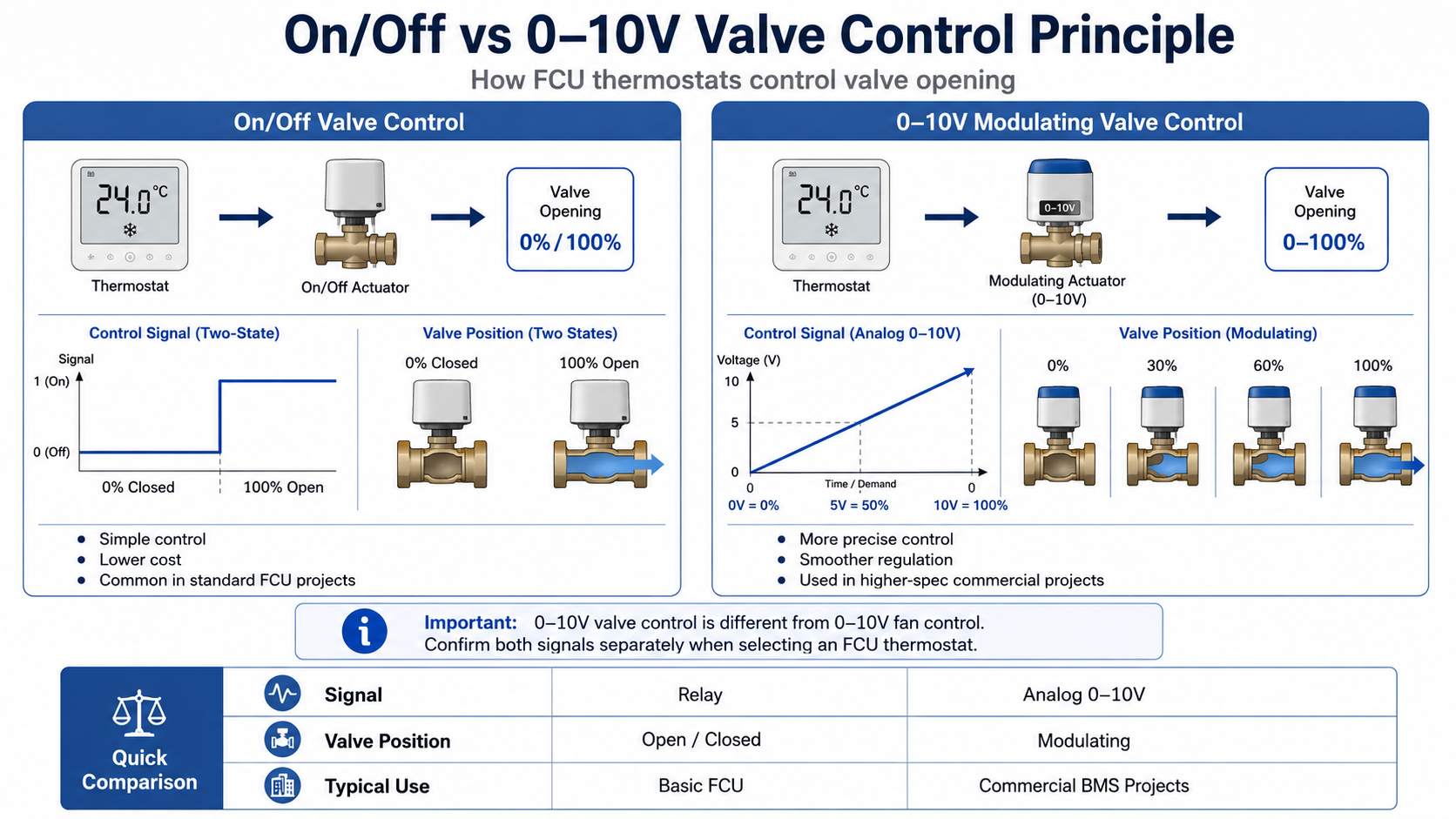
Neither option is always better.
The correct choice depends on the FCU design, valve actuator and project requirements.
Do Not Confuse 0-10V Fan Control With 0-10V Valve Control
This is one of the most common points of confusion when selecting an FCU thermostat.
A customer may simply ask for a:
“0-10V thermostat.”
But this does not tell us enough.
The 0-10V signal may be required for the fan, the valve, or both.
For example:
Fan control may be:
- ● 3-speed relay control
- ● 0-10V EC fan control
Valve control may be:
- ● On/Off
- ● 0-10V
- ● 3-point floating
These two signals must be confirmed separately.
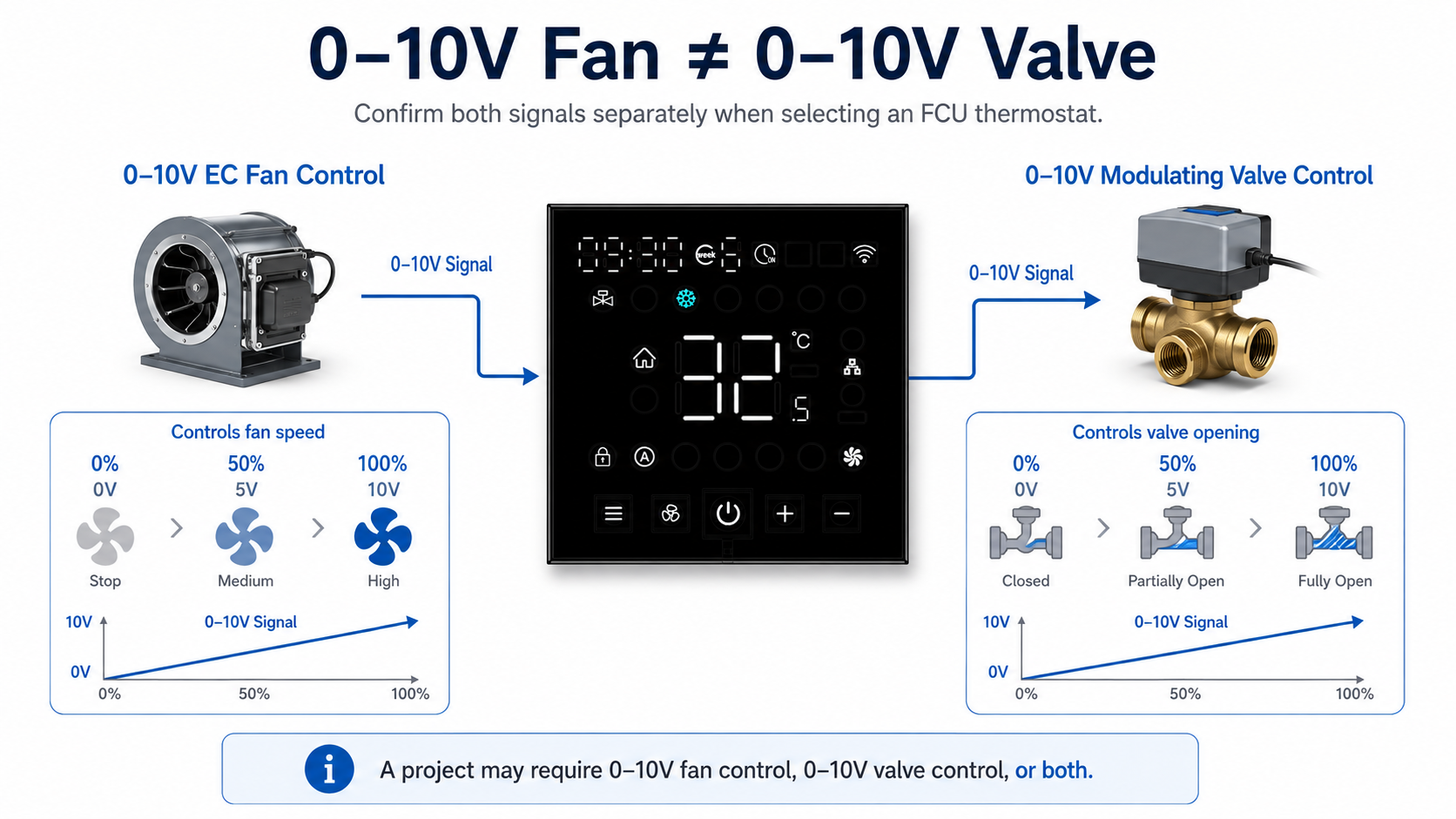
An FCU may use a 0-10V EC fan together with an On/Off valve.
Another project may use a 3-speed fan together with a 0-10V modulating valve.
Some systems may require both the fan and valve to use 0-10V signals.
If your project uses an EC fan, you can read our comparison of 3-speed vs 0-10V fan control in FCU applications.
This is why simply asking for a “0-10V FCU thermostat” is often not enough to select the correct model.
What Should You Confirm Before Choosing an FCU Thermostat?
Before selecting the thermostat, confirm these points first:
1. Is the FCU 2-pipe or 4-pipe?
A 2-pipe system normally uses one water circuit for either cooling or heating.
A 4-pipe system uses separate cooling and heating circuits.
The thermostat outputs will be different.
2. What type of fan is used?
Confirm whether the FCU uses:
- ● 3-speed fan
- ● 0-10V EC fan
This determines the required fan output from the thermostat.
3. What type of valve actuator is used?
Confirm whether the valve requires:
- ● On/Off control
- ● 0-10V control
- ● 3-point floating control
If possible, check the actuator wiring diagram or datasheet.
4. Is BMS communication required?
For commercial projects, the thermostat may also need:
- ● Modbus
- ● BACnet
- ● Other building control integration
Communication requirements should be confirmed separately from the fan and valve outputs.
If you want to compare the main FCU thermostat configurations available for commercial projects, see our Top 10 Fan Coil Thermostats for Commercial FCU Systems.
5. Are there any additional inputs or functions?
Depending on the project, the thermostat may also need:
- ● Keycard input
- ● Window contact
- ● External temperature sensor
- ● WiFi
- ● OEM interface or logo
These requirements should ideally be confirmed before the thermostat model is finalized.
A Simple Example
Suppose a project has the following FCU configuration:
- ● 2-pipe system
- ● 0-10V EC fan
- ● On/Off valve
- ● Modbus communication
The thermostat must therefore support:
2-pipe + 0-10V fan + On/Off valve + Modbus
A thermostat with only 0-10V valve output would not be suitable.
Now consider another project:
- ● 4-pipe system
- ● 3-speed fan
- ● 0-10V cooling valve
- ● On/Off heating valve
- ● BACnet communication
This requires a completely different thermostat configuration.
That is why FCU thermostat selection should always start from the actual equipment configuration rather than from the thermostat appearance or communication protocol alone.
For retrofit projects, wiring should also be checked carefully before replacing the existing thermostat. You can find some common FCU thermostat wiring mistakes in our guide.
Which Valve Control Should You Choose?
For a relatively simple FCU project where cost, installation and maintenance are the main concerns, an On/Off valve thermostat is often sufficient.
For projects requiring smoother temperature control, modulating water flow or more advanced HVAC control, a 0-10V modulating thermostat may be the better choice.
The most important point is compatibility.
The thermostat output must match the valve actuator input.
Before ordering an FCU thermostat, it is always better to check the valve actuator specification first.
Need Help Selecting the Right FCU Thermostat?
Beris Tech provides FCU thermostat configurations for both On/Off valves and 0-10V modulating valves, with options for 2-pipe / 4-pipe systems, 3-speed / EC fans, WiFi, Modbus and BACnet communication.
If you are not sure which configuration is suitable for your project, send us:
- ● 2-pipe or 4-pipe
- ● 3-speed or 0-10V EC fan
- ● On/Off or 0-10V valve
- ● Modbus, BACnet, WiFi or standalone control
- ● Project quantity
We can recommend a suitable thermostat configuration based on your FCU system.
