Digital Thermostats
Common FCU Thermostat Wiring Mistakes in Commercial HVAC Projects
In commercial HVAC projects, many FCU thermostat problems are actually caused by wiring mistakes during installation rather than thermostat failure itself.
We have seen situations where:
- ● the fan runs continuously,
- ● the valve does not respond,
- ● room temperature readings become unstable,
- ● or the thermostat cannot communicate with the BMS system.
In many cases, the issue is not complicated. It usually comes from incorrect wiring logic, wrong valve selection, or communication setup errors during commissioning.
This article discusses several common FCU thermostat wiring mistakes frequently seen in hotel, office, apartment, and retrofit HVAC projects.
If you are working on commercial FCU applications, you may also want to read our article about 2-pipe and 4-pipe FCU thermostat selection before installation.
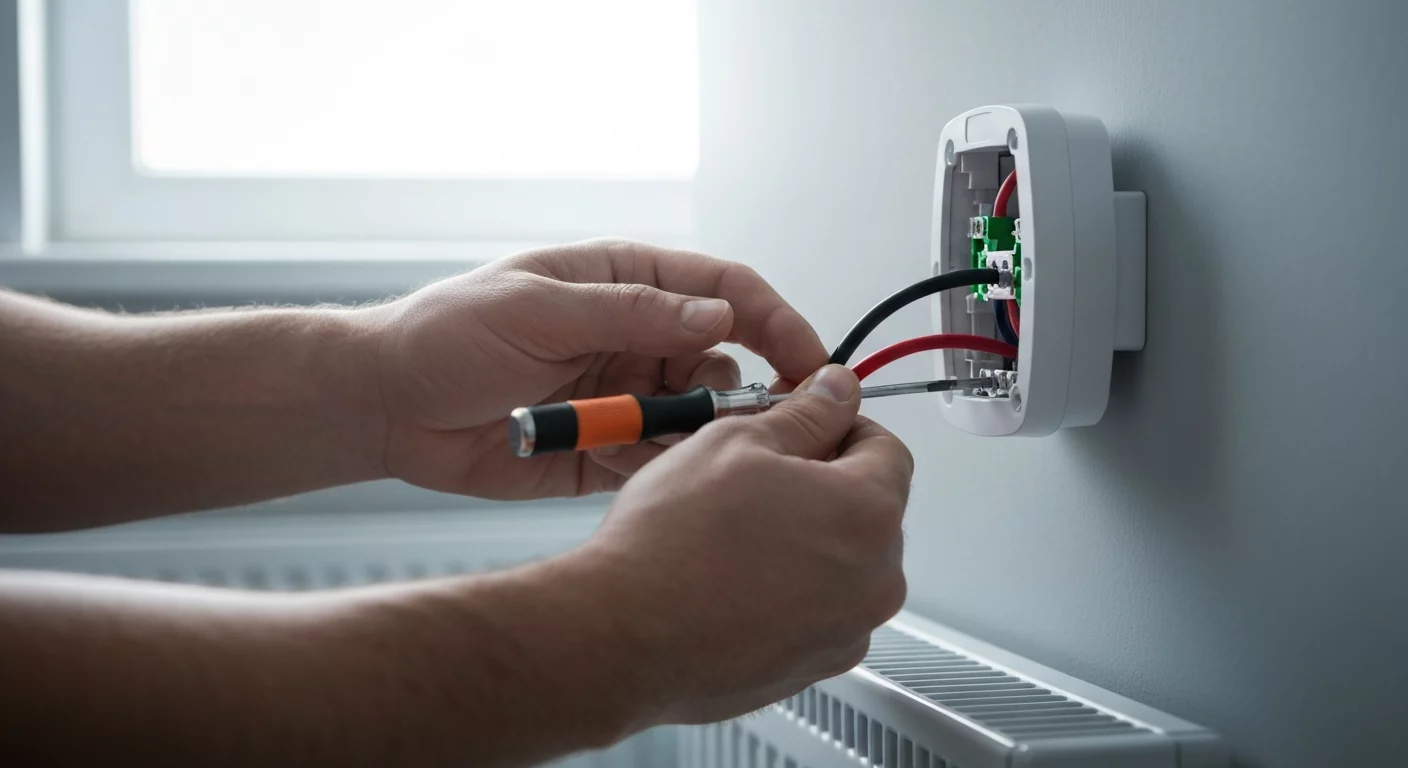
1. Confusing 2-Pipe and 4-Pipe FCU Systems
This is one of the most common mistakes in commercial projects.
In some renovation or hotel retrofit projects, installers may assume the existing FCU system is 2-pipe, while the building actually uses a 4-pipe configuration. This can easily cause heating and cooling control problems later.
For example, we have seen projects where cooling worked normally, but heating could not operate because only one valve output had been connected.
A typical 2-pipe FCU system usually uses:
- ● one water circuit,
- ● one valve output,
- ● and seasonal cooling/heating switching.
A 4-pipe FCU system is different.
It normally requires:
- ● separate cooling and heating valves,
- ● independent outputs,
- ● and different thermostat logic.
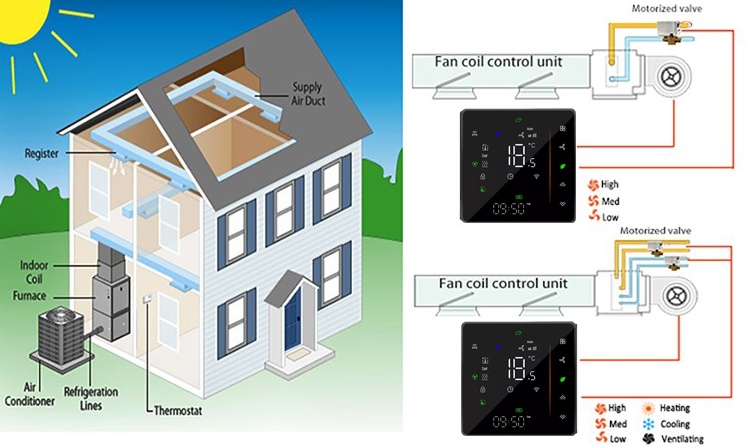
Before installation, it is always important to confirm:
- ● whether the FCU is 2-pipe or 4-pipe,
- ● the valve quantity,
- ● and the required control sequence.
In older buildings, this information is sometimes unclear, especially when replacing existing thermostats.
In many hotel and apartment FCU projects, standard wall-mounted thermostats such as the BT01-FCU series are commonly used for basic 2-pipe or 4-pipe applications.
These types of thermostats are often preferred in large-volume projects because the wiring logic is relatively straightforward during installation and commissioning.
2. Incorrect Fan Speed Wiring
Another common issue appears when connecting fan motors.
Today, many commercial FCU projects use either:
- ● traditional 3-speed AC fan motors,
- ● or EC motors with 0-10V control.
However, some installers still connect EC motors to standard 3-speed outputs by mistake.
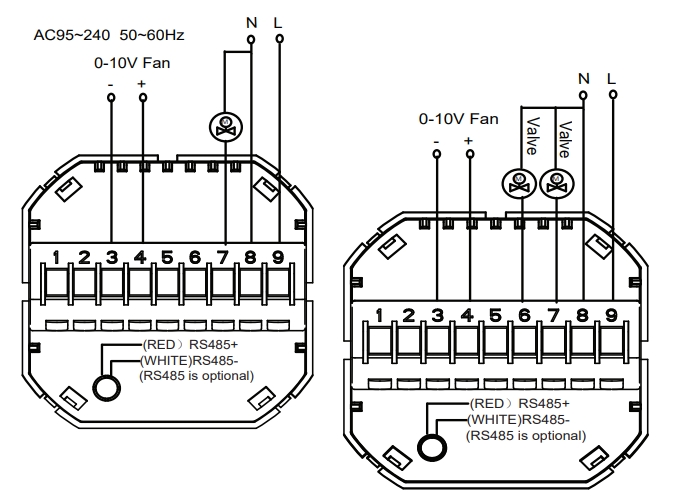
This may cause:
- ● unstable fan speed,
- ● fan failure,
- ● abnormal noise,
- ● or even motor damage.
In practice, this problem is more common in retrofit projects where the original FCU documentation is unavailable.
Before wiring the thermostat, it is important to verify:
- ● fan motor type,
- ● control signal type,
- ● and whether the system uses AC or EC motors.
In some European apartment projects, older FCUs may still use non-standard wiring colors, which can also confuse installers during replacement.
For projects using EC motors or modulating fan control, thermostat compatibility is also important.
Some commercial FCU thermostats support both traditional 3-speed fan control and 0-10V outputs, which can simplify retrofit projects when the original FCU specifications are unclear.
You may also be interested in our article about 3-speed vs 0-10V fan control in FCU applications.
3. Wrong Valve Type Connection
Valve wiring mistakes are also very common during commissioning.
Commercial FCU thermostats may support:
- ● ON/OFF valves,
- ● floating valves,
- ● or 0-10V modulating valves.
These control methods are completely different.
For example, in some projects, ON/OFF valves are accidentally connected to 0-10V outputs. As a result, the valve may remain permanently open or fail to respond correctly.
We have also seen situations where 24V actuators were connected directly to 220V outputs, damaging the actuator immediately after power-on.
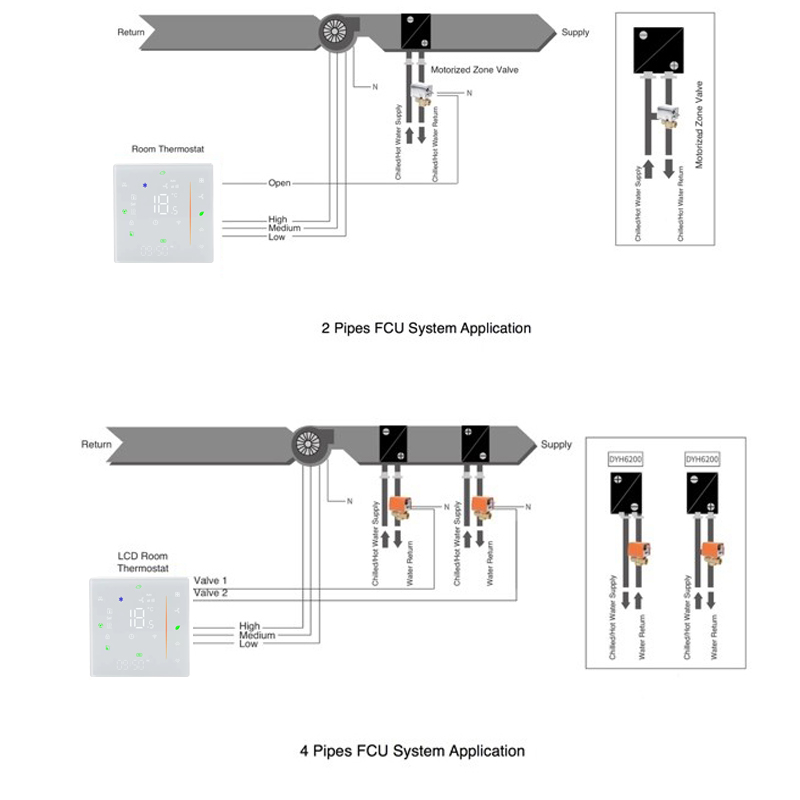
Before installation, installers should always verify:
- ● valve voltage,
- ● control signal type,
- ● actuator current,
- ● and wiring diagrams.
This is especially important in projects involving multiple valve suppliers.
4. External Sensor Wiring Problems
Many commercial FCU thermostats support external temperature sensors for:
- ● return air sensing,
- ● floor sensing,
- ● or remote room sensing.
However, sensor compatibility is often overlooked.
In practice, installers sometimes only discover the issue after the room temperature reading becomes inaccurate.
For example:
- ● a 10K NTC sensor,
- ● PT1000 sensor,
- ● or 50K sensor
cannot be used interchangeably.
Incorrect sensors may cause:
- ● inaccurate temperature display,
- ● unstable room control,
- ● or continuous heating/cooling operation.
This situation is relatively common when replacing older thermostats in existing buildings where the original sensor specifications are unknown.
5. Modbus and BACnet Communication Wiring Issues
Communication problems are extremely common during BMS commissioning.
In many cases, the thermostat itself is working correctly, but the communication network has wiring or addressing problems.
Typical issues include:
- ● reversed A/B polarity,
- ● missing communication ground,
- ● duplicate device addresses,
- ● incorrect baud rate,
- ● or improper termination resistor settings.
We have seen projects where thermostats appeared online individually, but communication became unstable once multiple devices were connected to the same RS485 loop.
This is especially common in long cable runs without proper shielding or termination.
For Modbus RS485 systems, installers should:
- ● use shielded twisted pair cable,
- ● maintain correct A/A and B/B polarity,
- ● and avoid star topology whenever possible.
For BACnet MSTP projects, network addressing and termination are particularly important.
In large hotel projects, a small communication wiring mistake can affect dozens of guest room thermostats simultaneously.
For commercial BMS projects, BACnet-compatible FCU thermostats are becoming increasingly common, especially in hotels, office buildings, and smart building applications.
In some projects, BACnet MSTP thermostats such as the BT03 series are used to simplify centralized monitoring and room-level HVAC control integration.
If you are comparing different communication protocols, you can also read our article about BACnet vs Modbus FCU thermostats for BMS projects.
6. Incorrect Power Supply Connection
Different FCU thermostats may support:
- ● 24VAC,
- ● 24VDC,
- ● 110VAC,
- ● or 220VAC power supplies.
Connecting the wrong voltage may permanently damage the thermostat.
This issue is more common in international projects where different voltage standards are used.
For example:
- ● some Middle East projects mainly use 220VAC,
- ● while certain BMS control systems may use 24VAC.
Before power-on, installers should always confirm:
- ● input voltage range,
- ● transformer specifications,
- ● and live/neutral wiring.
A simple voltage mistake during installation may damage both the thermostat and connected components.
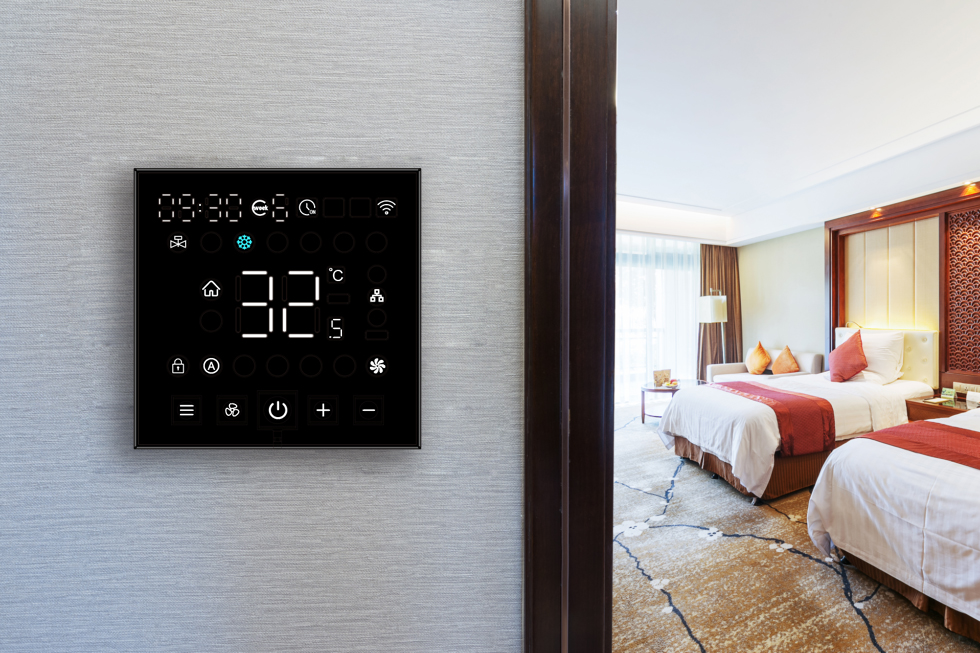
7. Keycard and Window Contact Wiring Mistakes in Hotel Projects
In hotel HVAC applications, FCU thermostats are often connected to:
- ● keycard systems,
- ● window contacts,
- ● or occupancy control systems.
Incorrect dry contact logic may cause:
- ● the thermostat to remain locked,
- ● fan operation to stop,
- ● or the room to stay permanently in energy-saving mode.
In some hotel projects, the issue is not discovered until guest rooms are already in operation.
Before commissioning, installers should verify:
- ● dry contact type,
- ● NO/NC logic,
- ● and occupancy control behavior.
This is particularly important when integrating thermostats with third-party hotel management systems.
8. Poor Cable Labeling During Installation
Large commercial buildings may contain:
- ● hundreds of FCUs,
- ● multiple communication loops,
- ● and several subcontractors working simultaneously.
Without proper cable labeling, troubleshooting later becomes extremely difficult.
In some retrofit projects, maintenance teams may spend hours identifying valve cables or communication lines simply because no labels were used during installation.
Although cable labeling seems simple, it can significantly reduce future maintenance time and commissioning costs.
Final Thoughts
In commercial HVAC projects, many FCU thermostat issues are actually related to installation logic, wiring details, or communication setup rather than product defects.
Careful verification before commissioning can significantly improve system stability, especially for:
- ● 2-pipe and 4-pipe systems,
- ● EC fan motors,
- ● Modbus/BACnet communication,
- ● valve compatibility,
- ● and hotel keycard integration.
At Beris Tech, we work with various commercial FCU thermostat applications ranging from standard 2-pipe hotel projects to BACnet-integrated BMS systems.
Depending on project requirements, different thermostat series may be selected for different installation environments.
For example:
- ● standard FCU applications may prioritize simple wiring and stable fan control,
- ● while BMS projects often require Modbus or BACnet communication integration for centralized building management.
If you are still selecting a thermostat for your project, you can also read our guide on how to choose the right FCU thermostat for HVAC systems.
For a broader comparison of commercial fan coil thermostat options, you may also refer to our FCU thermostat selection and comparison guide.
Understanding real installation challenges helps improve both system stability and project commissioning efficiency.