Digital Thermostats
EPBD and BMS Retrofit: How to Select FCU Thermostats for Room-Level HVAC Control
The revised Energy Performance of Buildings Directive (EPBD) is pushing European buildings toward better energy performance, smarter control and more digital building operation.
For commercial buildings, this is especially relevant to HVAC control.
The directive requires EU countries to introduce building automation and control requirements for certain non-residential buildings. Under the current framework, systems above 290 kW are already covered, while the threshold is set to expand to systems above 70 kW by the end of 2029, where technically and economically feasible.
European Commission’s Energy Performance of Buildings Directive (EPBD)
For HVAC contractors, BMS integrators and building owners, this raises a practical question:
What should be considered at room level when selecting or replacing FCU thermostats?
The answer is not simply “choose a thermostat with BACnet” or “add WiFi”.
A good room controller needs to match the actual fan coil system, the building automation strategy and the way each room is expected to operate.
What Does EPBD Mean for HVAC Control in Commercial Buildings?
The revised EPBD places more emphasis on building automation, energy monitoring, interoperability and indoor environmental quality.
Building automation and control systems are expected to support functions such as:
- ● monitoring and analysing energy use
- ● detecting losses in system efficiency
- ● allowing adjustments to building energy use
- ● communicating with connected technical building systems
- ● supporting interoperability between different technologies and manufacturers
The revised directive also strengthens requirements related to indoor environmental quality and building automation and control.
This does not mean that every thermostat must individually provide all these functions.
The thermostat is only one part of the building control architecture.
Why Room-Level FCU Control Matters?
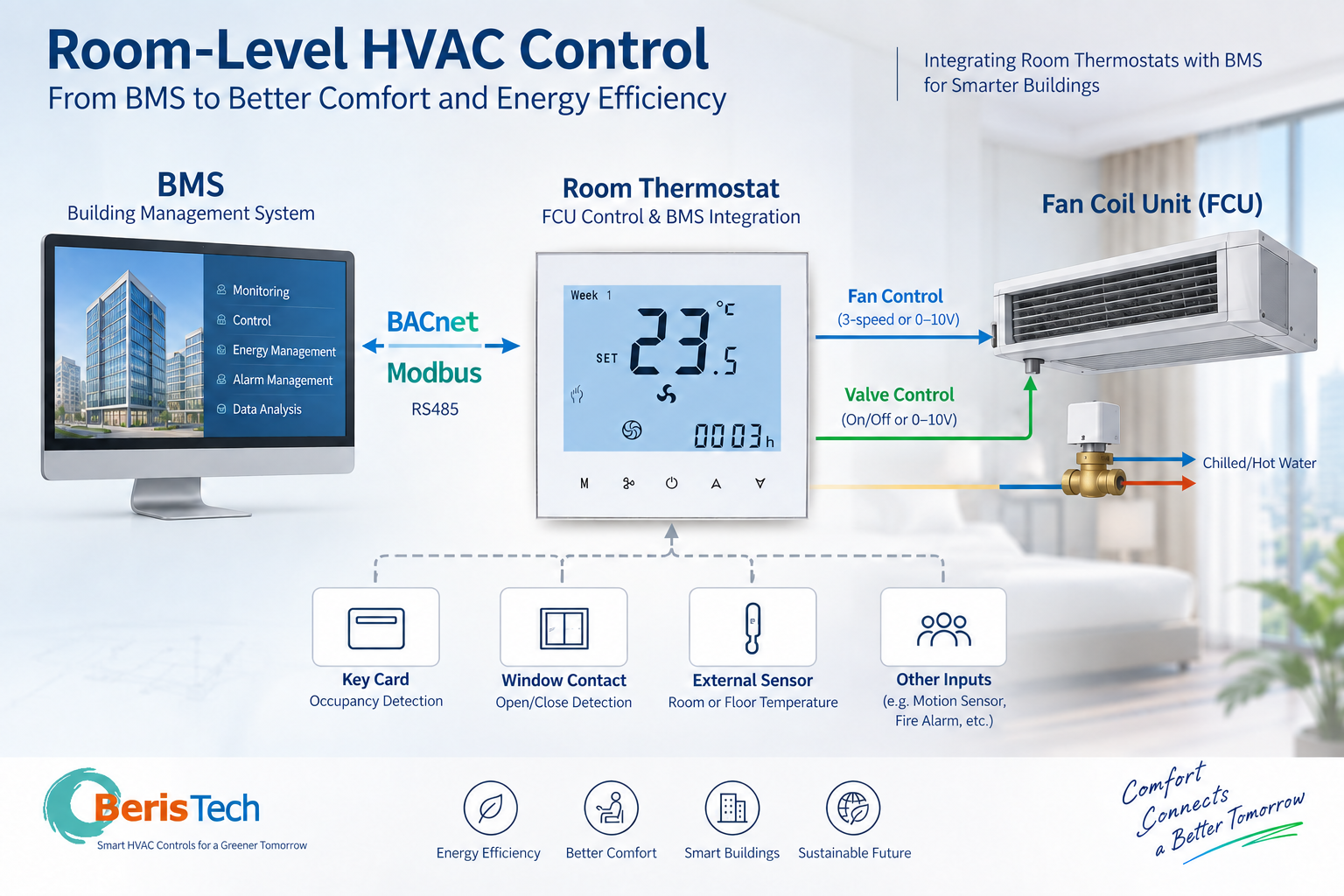
A central BMS can calculate schedules, collect data and supervise the building.
But comfort and energy consumption are ultimately affected by what happens inside each room.
Consider a hotel with 300 guest rooms.
The BMS may know when the hotel is occupied, but each room can still have a different condition:
- ● one room is vacant
- ● another guest has opened the window
- ● one room requires cooling
- ● another is already at setpoint
- ● some rooms may need restricted temperature adjustment
- ● housekeeping may temporarily enter an unoccupied room
The same principle applies to offices, schools, hospitals and other commercial buildings.
Room-level control allows the HVAC system to respond to actual demand instead of treating the entire building as one operating condition.
For FCU systems, this control normally happens through the room thermostat.
But in buildings using fan coil units, the room thermostat often becomes the point where the central BMS meets the actual room-level HVAC equipment.
That makes thermostat selection more important than it may appear.
Key FCU Thermostat Functions to Consider for BMS Retrofit
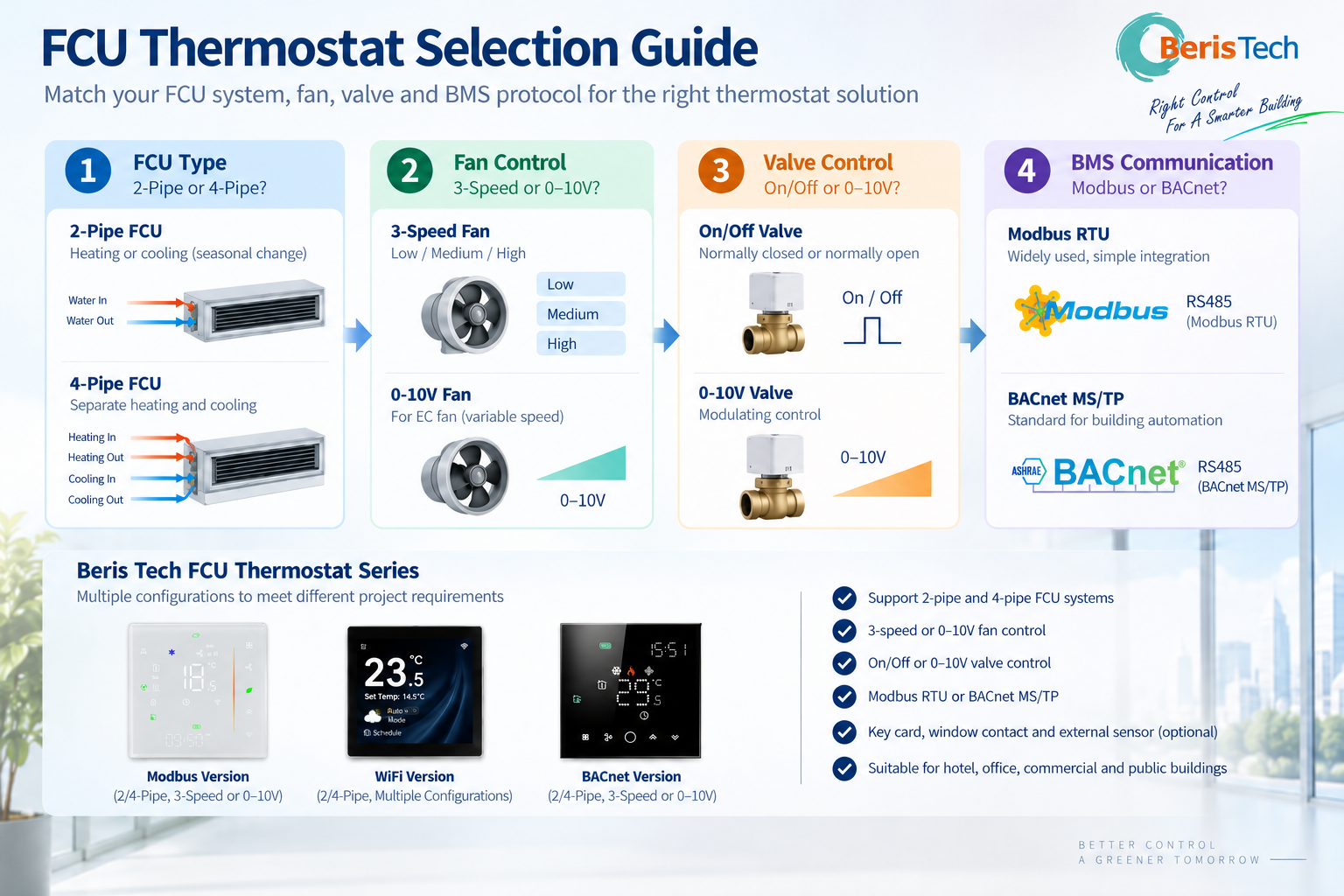
When upgrading an existing building, choosing the communication protocol is only one part of the job.
Before selecting the thermostat, several basic control requirements should be confirmed.
1. 2-Pipe or 4-Pipe FCU System
The first question is the FCU configuration.
A 2-pipe system normally uses the same water circuit for heating and cooling depending on seasonal operation.
A 4-pipe system has separate heating and cooling circuits and can offer more flexible room control.
The thermostat must match the actual pipe configuration and valve control logic.
For more detail, see our 2-pipe vs 4-pipe FCU thermostat selection guide.
2. Does the Fan Use 3-Speed or 0–10V Control?
Traditional fan coil units often use three relay outputs:
- ● Low
- ● Medium
- ● High
Newer EC fans may use a 0–10V signal instead.
These are different control methods.
A thermostat designed for three fan-speed relays cannot automatically control a 0–10V EC fan.
This is one of the parameters that should always be confirmed before quotation.
You can also read our guide on 3-speed vs 0–10V fan control in FCU applications.
3. How Is the Valve Controlled?
FCU valve actuators may use:
- ● On/Off control
- ● 0–10V modulating control
- ● 3-point floating control
The thermostat output must match the actuator.
One common misunderstanding is simply asking for a “0–10V thermostat”.
That is not enough information.
The 0–10V signal may be required for:
- ● the fan
- ● the valve
- ● or both
These configurations require different thermostat hardware and control logic.
For a deeper explanation, see our On/Off vs 0–10V valve control guide.
BACnet or Modbus?
For commercial BMS projects, BACnet and Modbus are two of the most common communication options.
Neither is automatically better.
The correct choice depends mainly on the existing building automation architecture.
Modbus RTU
Modbus RTU is widely used in HVAC systems because it is simple, mature and supported by many controllers, gateways and BMS platforms.
It can be a practical choice when the building already operates an RS485 Modbus network.
BACnet MS/TP
BACnet was developed specifically for building automation and is widely used in commercial BMS systems.
It can provide a more standardized integration approach when the building already uses BACnet devices.
The practical rule is:
Choose the thermostat communication protocol according to the BMS, not independently from it.
For a detailed comparison, see our BACnet vs Modbus thermostat guide.
What Should the BMS Be Able to Read?
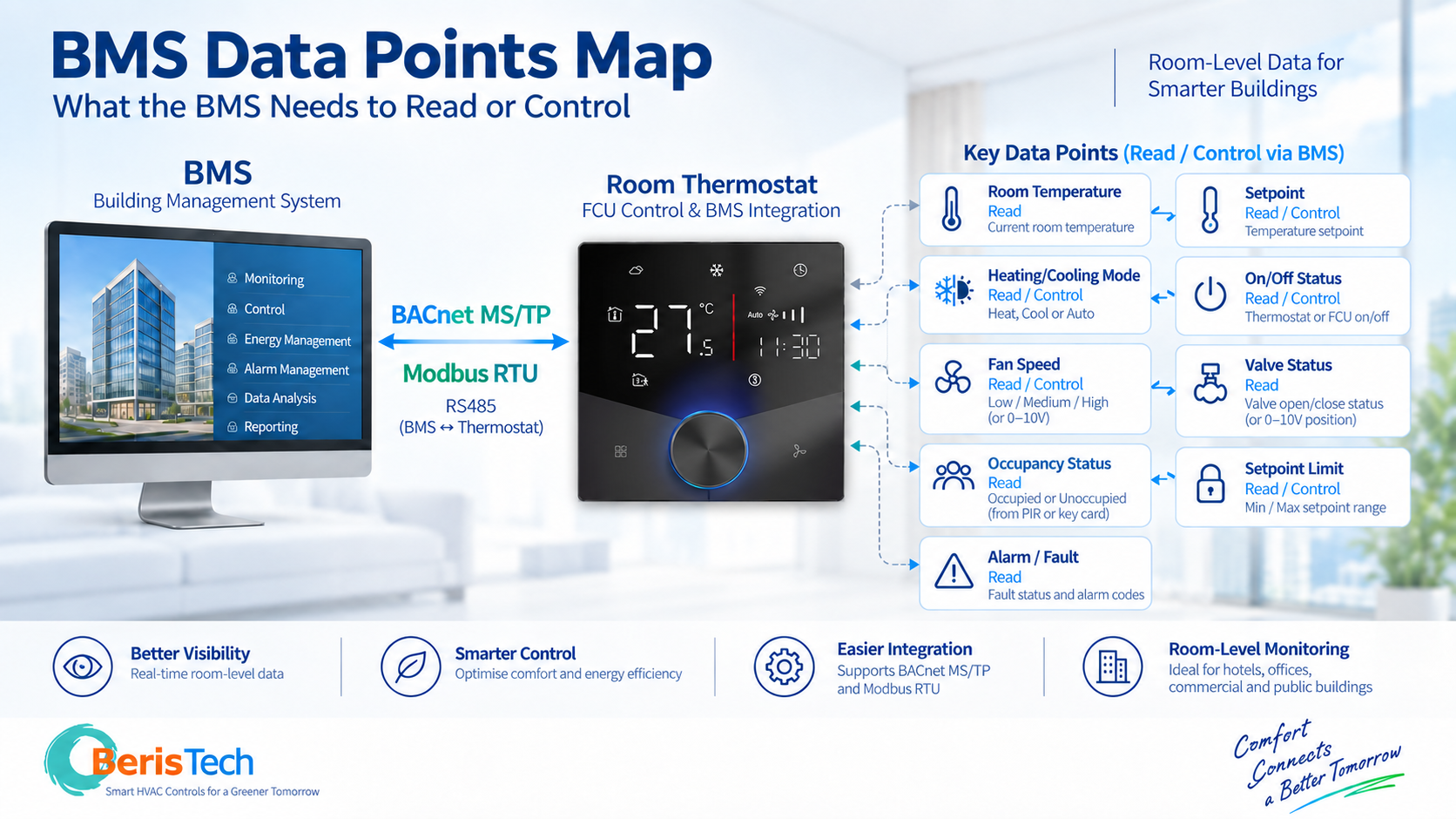
Connecting the thermostat to the BMS is only the beginning.
The more important question is:
Which data points does the project actually need?
Typical requirements may include:
- ● room temperature
- ● temperature setpoint
- ● heating or cooling mode
- ● fan speed
- ● thermostat On/Off status
- ● valve output status
- ● occupancy status
- ● operating mode
- ● alarm information
- ● setpoint limits
Not every project needs every point.
That is why the BACnet object list or Modbus register list should be reviewed before the thermostat is approved.
This becomes especially important for OEM projects or retrofit projects where the BMS integrator has already defined a specific control strategy.
Occupancy and Window Control
Communication protocol gets a lot of attention, but simple room-level inputs can sometimes create very meaningful energy savings.
Occupancy or Key Card Input
In a hotel, the thermostat may receive a signal from the key card system.
When the guest leaves the room, the controller can move to an energy-saving condition instead of continuing normal operation.
This does not necessarily mean completely switching the FCU off.
The project may instead allow a wider temperature range during vacancy.
The exact logic should be defined according to the building's operating strategy.
Window Contact
If a window is open while the room continues heating or cooling, energy is being wasted.
A window contact input allows the thermostat to respond automatically when the window is opened.
This function is particularly useful in:
- ● hotels
- ● serviced apartments
- ● offices
- ● schools
- ● naturally ventilated buildings
- ● Setpoint Limits and Deadband
In many commercial buildings, users should not have unlimited control over the temperature setpoint.
For example, the BMS may allow adjustment only within a defined range.
This helps balance occupant comfort with energy efficiency.
Deadband is also important in systems with automatic heating and cooling.
A suitable deadband helps avoid frequent switching between heating and cooling modes.
For BMS-connected projects, it can also be useful to allow these parameters to be adjusted centrally.
External Temperature Sensors
The thermostat location does not always represent the actual room condition.
Temperature measurement may be affected if the thermostat is installed:
- ● near a door
- ● in direct sunlight
- ● on an external wall
- ● close to heat-producing equipment
- ● in an area with poor airflow
In these situations, an external temperature sensor may provide a better measurement point.
For retrofit projects, always check whether the existing installation already uses an external sensor before replacing the thermostat.
Hotel and Office Projects May Need Different Control Strategies
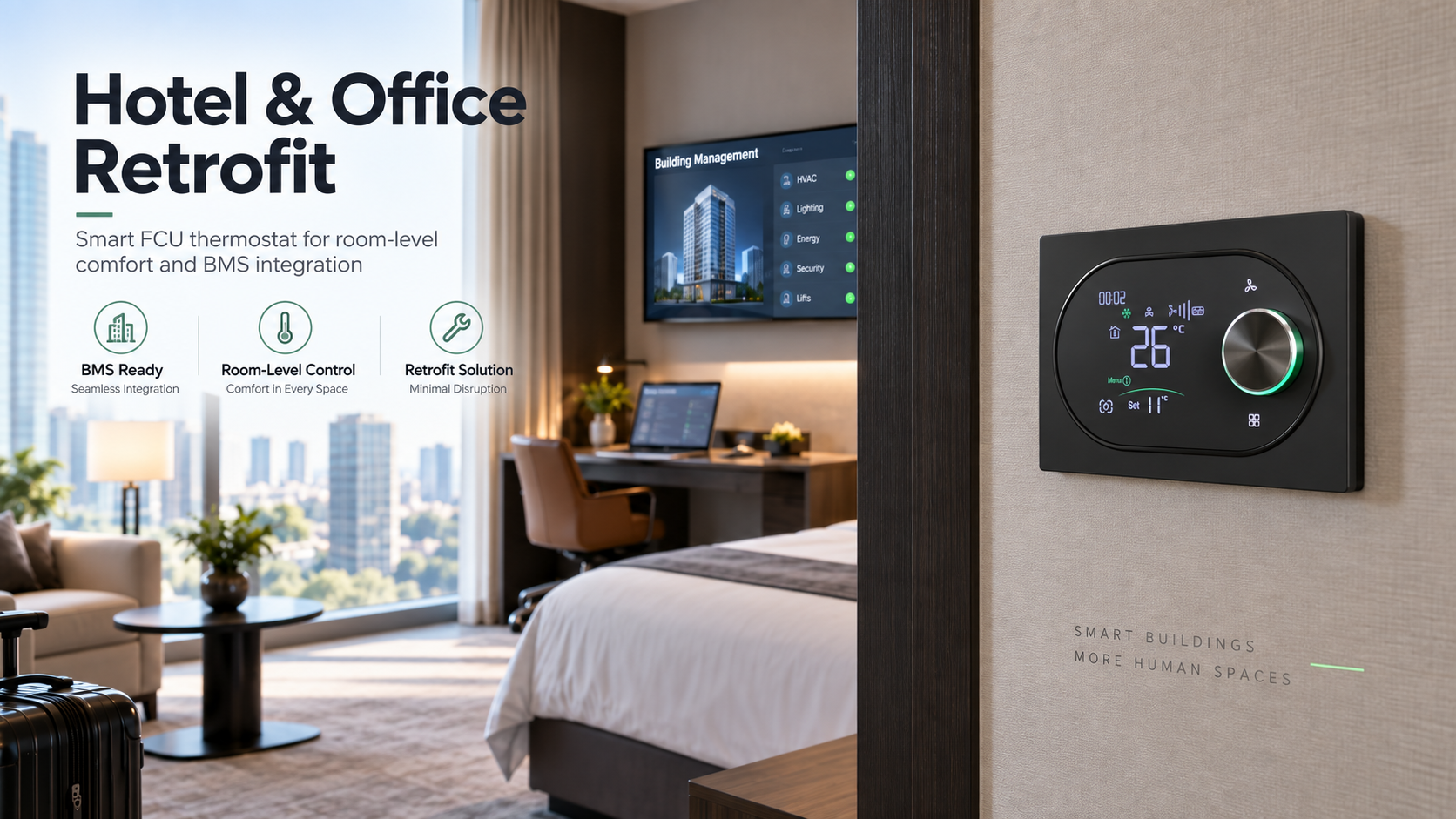
There is no single thermostat configuration for every commercial building.
Hotel Projects
Hotel FCU projects often require:
- ● key card input
- ● window contact
- ● temperature limitation
- ● easy guest operation
- ● quiet fan control
- ● centralized monitoring
- ● reliable 2-pipe or 4-pipe control
For more detailed hotel-specific considerations, see our FCU thermostat guide for hotel projects.
Office Buildings
Office projects may focus more on:
- ● BMS integration
- ● scheduled operation
- ● occupancy control
- ● centralized setpoint management
- ● zone-level monitoring
- ● Schools and Public Buildings
Typical priorities may include:
- ● simple operation
- ● restricted setpoint adjustment
- ● centralized control
- ● easy maintenance
- ● energy monitoring
The thermostat hardware may look similar, but the control logic can be very different.
Can You Upgrade the Controls Without Replacing the FCU?
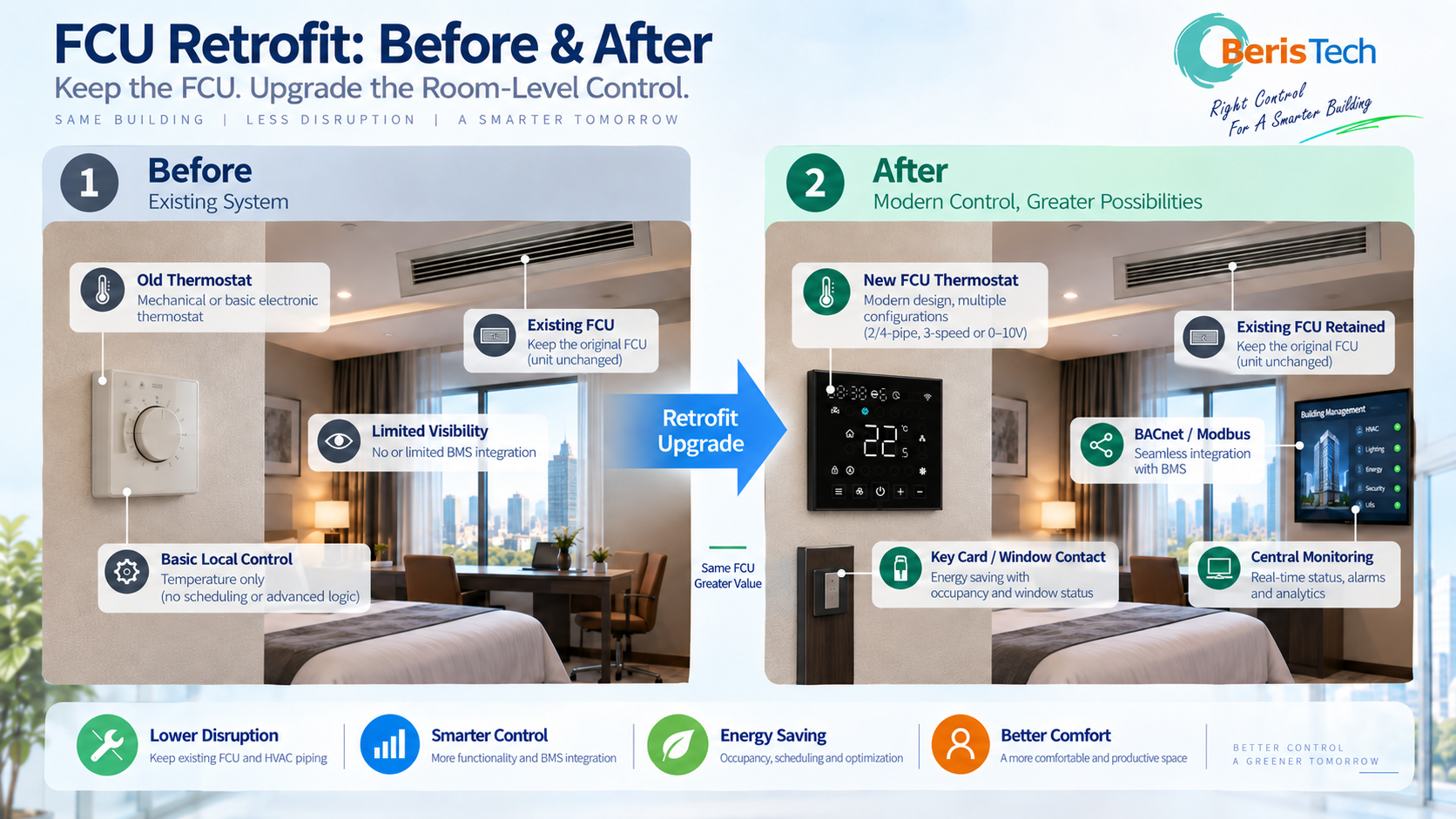
In many retrofit projects, yes.
The fan coil units themselves may still be mechanically sound while the original thermostats are outdated.
In this situation, the building may be able to keep the existing FCUs and upgrade only the room-level control system.
But thermostat replacement is not always plug-and-play.
Before selecting a replacement, confirm:
| Item | What to Check |
|---|---|
| FCU system | 2-pipe or 4-pipe |
| Fan | 3-speed or 0–10V |
| Valve | On/Off, 0–10V or 3-point |
| Power supply | 24V or line voltage |
| Communication | Standalone, Modbus or BACnet |
| BMS points | What needs to be read or controlled |
| Occupancy | Key card / occupancy input |
| Window contact | Required or not |
| Sensor | Built-in or external |
| Installation | Wiring and wall box dimensions |
| Project | Retrofit or new build |
A wiring diagram is often more useful than the old thermostat model number alone.
Selecting FCU Thermostats for an EPBD-Driven Retrofit
EPBD should not be treated as a thermostat specification.
The important question is whether the room controller supports the control strategy required by the building.
Depending on the project, that may include:
- ● open BMS communication
- ● room-level temperature control
- ● occupancy-based operation
- ● window contact
- ● setpoint limitation
- ● fan and valve status
- ● configurable operating parameters
- ● maintainable control software
The exact requirement should always be confirmed with the BMS integrator or project consultant.
How Beris Tech Support FCU Retrofit Projects?
Beris Tech provides FCU thermostats for different commercial HVAC control applications, including standalone, Modbus and BACnet versions.
Depending on the thermostat model and project configuration, available options can include:
- ● 2-pipe and 4-pipe control
- ● 3-speed fan
- ● 0–10V fan
- ● On/Off valve
- ● 0–10V valve
- ● Modbus RTU
- ● BACnet MS/TP
- ● key card input
- ● window contact
- ● external sensor
- ● setpoint limitation
- ● configurable control parameters
For a broader comparison of different configurations, see our FCU thermostat selection guide.
For project-based applications, we recommend confirming the control requirements before quotation and sample testing.
Final Thoughts
The direction of European building control is becoming clear: HVAC systems are expected to become more measurable, connected and responsive to actual demand.
For FCU projects, this means the thermostat is no longer only a device for changing room temperature.
It is becoming part of the room-level building control system.
But successful retrofit projects still begin with very practical questions:
- ● What fan is installed?
- ● How is the valve controlled?
- ● What does the BMS need to read?
- ● How is occupancy handled?
- ● What wiring already exists?
Answering these questions before selecting the thermostat can prevent many compatibility and commissioning problems later.
Planning an FCU retrofit or BMS integration project?
Send us your existing thermostat model, wiring diagram and control requirements. Beris Tech can help evaluate a suitable FCU thermostat configuration before sample testing.