Digital Thermostats
3-Speed vs 0-10V Fan Control in FCU Applications – What Engineers Should Know
Fan control is one of the most important functions in a commercial fan coil unit (FCU) system. In hydronic HVAC applications, the room thermostat is responsible not only for temperature regulation, but also for coordinating fan speed and valve operation.
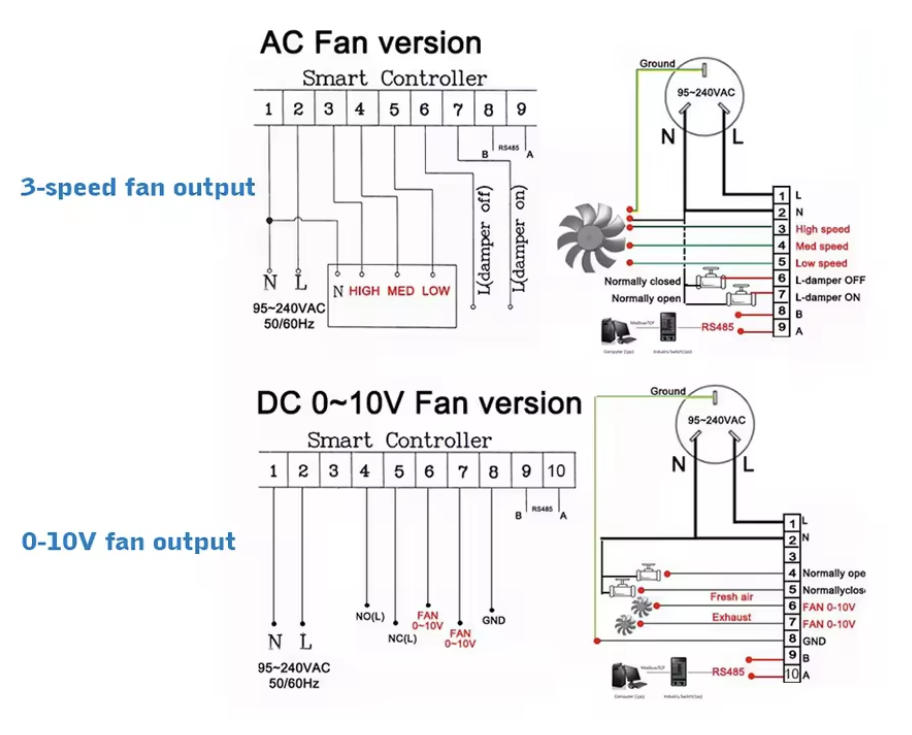
Two common fan control methods used in FCU systems are 3-speed relay control and 0-10V modulating control. While both approaches are widely used in commercial projects, they differ significantly in motor compatibility, energy performance and control precision.
This article explains how each method works, their advantages and limitations, and how to determine which one is suitable for your specific FCU project.
What Is Fan Control in an FCU System?
In a typical FCU setup, the thermostat controls:
- ● Fan motor operation
- ● Heating or cooling valve
- ● System mode (cooling/heating)
The fan motor is responsible for distributing conditioned air into the space. Depending on the motor type and project requirements, the control method may be based on fixed speed switching or variable analog modulation.
Understanding the difference between these two approaches is essential when selecting a compatible FCU thermostat.
How 3-Speed Fan Control Works?
3-speed fan control is the traditional method used in many AC motor-based FCU systems.
In this configuration:
- ● The thermostat provides relay outputs
- ● The fan motor has separate terminals for Low / Medium / High speeds
- ● The thermostat energizes one speed at a time
This method is simple and widely adopted in:
- ● Hotels
- ● Apartments
- ● Residential buildings
- ● Cost-sensitive retrofit projects
Advantages of 3-Speed Control
- ● Simple wiring
- ● Lower component cost
- ● High reliability
- ● Easy replacement in existing installations
Limitations
- ● Only three fixed speed levels
- ● No smooth modulation
- ● Moderate energy efficiency compared to EC systems
3-speed control remains a practical and stable solution in many commercial FCU applications where simplicity and cost control are priorities.
How 0-10V Fan Control Works (EC Fan Systems)?
0-10V control is typically used with EC (electronically commutated) motors.
Instead of switching between fixed speeds, the thermostat outputs a continuous analog signal between 0 and 10 volts. The EC motor adjusts its speed proportionally based on the signal level.
This allows:
- ● Smooth speed modulation
- ● Precise airflow adjustment
- ● Reduced energy consumption
- ● Lower noise levels
0-10V control is commonly used in:
- ● Modern office buildings
- ● Energy-efficient projects
- ● Premium hotels
- Smart building applications
Advantages of 0-10V Control
- ● Continuous speed adjustment
- ● Higher energy efficiency
- ● Better comfort control
- ● Suitable for advanced control strategies
Limitations
- ● Higher initial cost
- ● Requires EC motor compatibility
- ● More careful commissioning
Key Differences Between 3-Speed and 0-10V Control
| Feature | 3-Speed Control | 0-10V Control |
|---|---|---|
| Motor Type | AC motor | EC motor |
| Control Signal | Relay switching | Analog modulation |
| Speed Levels | 3 fixed speeds | Continuous variable |
| Energy Efficiency | Medium | High |
| Noise Performance | Standard | Lower at partial load |
| Typical Applications | Hotel / Residential | Office / Energy-focused projects |
| System Complexity | Simple | Moderate |
The choice is not about which method is “better,” but which one matches the mechanical design and performance requirements of the project.
Which One Should You Choose for Your FCU Project?
When evaluating fan control type, consider the following:
1. Existing Motor Type
If the project uses traditional AC motors, 3-speed switching is required.
If EC motors are installed, 0-10V control can be utilized.
2. Energy Efficiency Requirements
Projects targeting higher energy performance standards often prefer EC motors with modulating control.
3. Budget Considerations
3-speed systems are generally more economical for large-volume hotel or apartment projects.
4. Retrofit vs New Construction
Retrofit projects typically follow existing motor design, while new projects have flexibility in system selection.
Compatibility Considerations for FCU Thermostats
Before selecting an FCU thermostat, confirm:
- ● Is the fan motor AC or EC?
- ● Does it require relay switching or 0-10V signal?
- ● What is the valve control type (On/Off, 0-10V, 3-point)?
- ● What is the power supply (24VAC or 230VAC)?
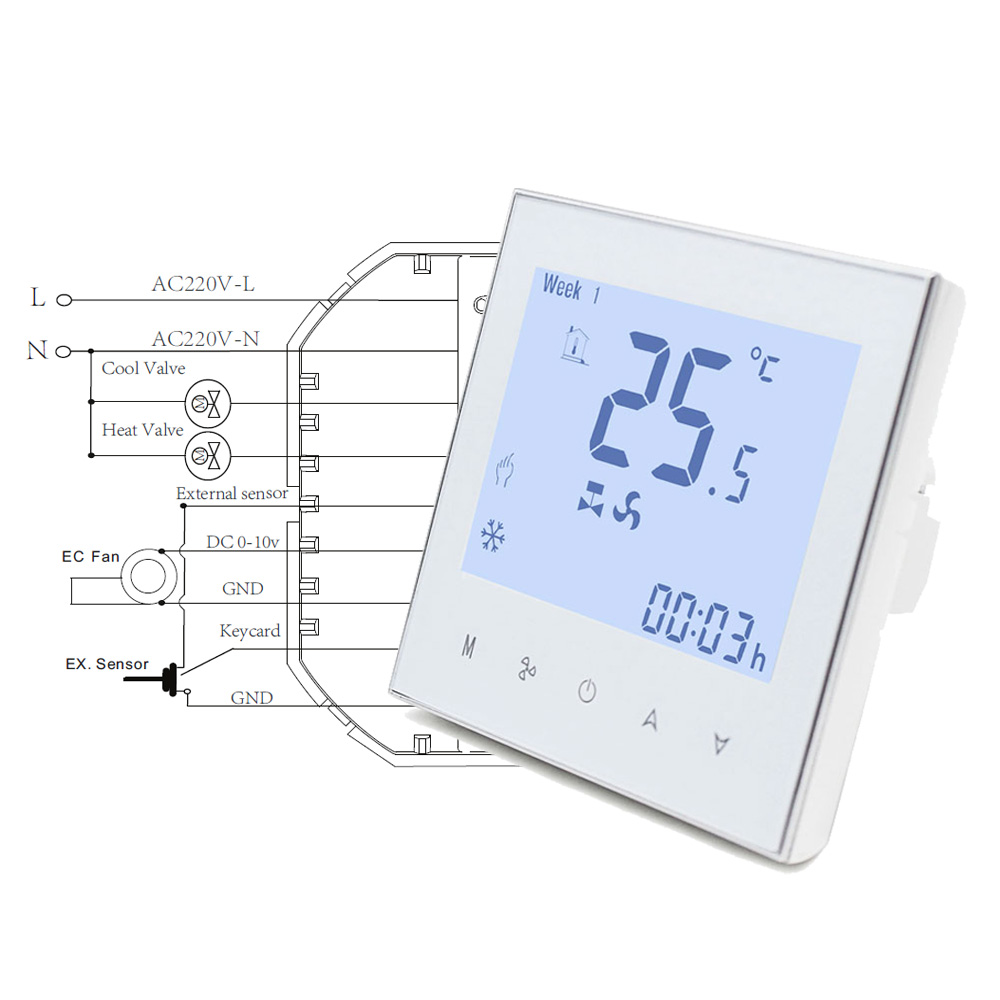
Selecting a thermostat that does not match the motor type may result in improper operation or control failure.
For a broader overview of how to evaluate thermostats for commercial fan coil systems, you can refer to our
FCU thermostat project selection guide.
Final Thoughts
Both 3-speed and 0-10V fan control methods are widely used in commercial FCU systems. The appropriate choice depends on motor configuration, project budget, energy targets and system complexity.
Understanding these differences helps engineers, contractors and system designers select the correct thermostat and avoid compatibility issues during installation.
In commercial HVAC projects, aligning the thermostat control type with the fan motor design is a fundamental step toward reliable and efficient FCU performance.
